

Backyard Pool Remodeling Costs — And Why Doing It Wrong Can Be Dangerous
Backyard pool remodeling isn’t just about concrete, skimmers, and shiny new tile. There are standards, national codes, safety regulations, and flow calculations that exist for a reason. At Pool Envy®, we remodel and repair pools the correct way — the code-correct way — not “the way everybody else does it.”
A lot of older backyard pools were built with outdated practices, especially when it comes to plumbing and suction safety. If we’re going to remodel your pool, we’re going to make it safer, more efficient, and compliant with modern ASTM/ANSI and VGB Act requirements.
Why Homeowners Get Misled on Pool Remodeling
Let’s start with something uncomfortable but true: what you don’t know absolutely can hurt you.
Could I walk into an ER and throw in some stitches? Glue a wound shut? Of course not. The same way most people can’t walk into small claims court and magically “win” without understanding counterclaims, interrogatories, and procedure. These things look simple until you’re responsible for the outcome.
Swimming pools fall into that category. YouTube makes everyone feel like a doctor, lawyer, or builder. But pools involve structural loads, electrical bonding, hydraulics, entrapment physics, and pressure-rated materials. Using the wrong PVC fitting (DWV vs. pressure-rated), skipping GFCIs, or assuming something is “grandfathered” can get someone hurt — or worse.
GFCIs were required in the 1980s. Many people still insist they weren’t. This is what we deal with daily.
Let’s begin the real discussion.
“Can I Get a Quote to Fix My Concrete and Replace a Skimmer?”
This is where most remodeling conversations start. And the homeowner expects something like $1,000.
The reality? A proper skimmer replacement and surrounding structural concrete repair typically runs $10,000+ when done correctly.
That sounds outrageous if you think the work is as simple as lifting a block of concrete and gluing a new skimmer in. But that is not how pools work — and it’s not how safe remodeling works.
Pool Plumbing Requirements for Remodeling (And Why 1.5” Pipe Is Dangerous)
As licensed contractors, our responsibility is not to “patch the thing you pointed at.” Our responsibility is to reduce the risk of injury, entrapment, or mechanical failure — even if nobody has been hurt yet.
Here’s the uncomfortable truth:
1.5” plumbing can only move about 35 gallons per minute safely.
Most pumps installed on older pools try to force more water than the pipe can handle. When that happens:
- Water speeds up → dangerous velocities
- Friction increases → wasted energy
- Sand filters channel → poor water clarity
- Pipes strain → fittings fail
Faster isn’t better. Safer is better.
The Equalizer Problem (And Why It’s a Hazard)
This specific pool has a skimmer equalizer — a suction diverter inside the skimmer that pulls from the main drain. That device alone should terrify you. It’s designed to bypass the skimmer and pull water from a point that has historically caused entrapments.
Now combine that with:
- 1.5” suction line from skimmer to pump
- Three 1.5” return lines going back to the pool
- Not enough pipe diameter anywhere
This creates imbalance, inefficiency, safety hazards, and chronic maintenance problems.
How We Fix It — The Right Way
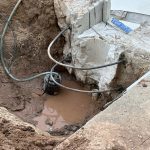
Step one: we remove the surrounding concrete — not just a small cutout. Everything between the two expansion joints has to go because it’s all structurally compromised.
Step two: we install a modern, properly sized skimmer and increase the suction pipe to 4 inches. This is a massive safety and efficiency improvement. Think of it like going from a two-lane road to a ten-lane highway. Same flow, dramatically less friction, much safer velocities.
Step three: we repurpose the equalizer — it becomes a fourth return instead of a suction point. No more hazardous deep-end suction. Better mixing. Safer hydraulics.
Step four: we rebuild the deck, restore structural integrity, and bring the pool up to modern standards.
Efficiency & Safety Improvements During Remodeling
While we’re remodeling, we also evaluate:
- Electrical bonding (NEC 680.26 compliance)
- GFCI protection and breaker upgrades
- Equipment sizing and filtration
- Variable-speed pump conversion
- Plumbing routing and flow balance
This isn’t “extra.” This is the baseline for a safe, long-lasting pool.
A properly updated pool will:
- Circulate better
- Filter faster
- Use less energy
- Stay clearer
- Break down less
“Why Don’t Other Companies Do This?”
Because standards take time. Training takes time. Doing things correctly takes time. And most pool companies simply don’t want to work to that level.
For us, safety isn’t optional — it’s non-negotiable.
When the risk is suction entrapment, hair entanglement, electrical shock, or evisceration, we stay on the side of standards every time.
Our Training & Expertise
Since January 1, 2023, our staff has completed:
- 145+ hours of in-person training across three states
- 48 hours of advanced technical education
- Multiple certification exams
We invest heavily in education because we believe safety is the priority — not an add-on.
Help Us Share This Message
We invest our time writing these articles to help homeowners understand the real risks and realities behind “simple” pool repairs. If this information helped you, please share it and help spread a safety-first approach to backyard pools.
-

- Trenching plumbing for pool

-
- Concrete Skimmer Replacement

-
- Concrete Skimmer Removal

-
- Concrete Deck Removal


-
- what is a pool skimmer




-
- Finished Concrete Deck

