

Why Pool Plaster Results Vary: Understanding Pool Plaster Problems
Pool plaster problems rarely begin with one isolated mistake. Waves, discoloration, cracking, roughness, inconsistent texture, and premature deterioration can reflect the combined effects of substrate condition, surface geometry, material handling, weather, application, filling, and startup.
New plaster is the visible result of an entire construction process
When a newly resurfaced pool does not look or perform as expected, attention naturally turns to the finish material. Owners may assume that the plaster brand, color, aggregate, or proposal amount should explain the outcome.
In reality, the visible finish is the last layer in a much larger process. The same nominal finish can produce very different results depending on what existed beneath it, how the surface was prepared, how consistently the material was mixed and handled, what environmental conditions existed during application, and how the pool was filled and started afterward.
Investigating pool plaster defects therefore requires more than identifying a stain, crack, wave, or rough area. It requires looking at the renovation as a system.
Pool plaster quality is a process, not a price
Proposal amounts can differ for legitimate reasons, but price alone does not disclose workmanship, preparation, quality control, or likely performance.
One contractor may invest substantial time evaluating the existing surface, removing unsound material, correcting transitions, controlling batches, monitoring weather, and documenting startup. Another proposal may include fewer steps. A third contractor may charge substantially more without delivering greater control over any of those variables.
The number at the bottom of a proposal does not reveal which situation applies. An expensive renovation may be excellent, average, or poor. The same is true of a lower proposal.
The useful question is not simply whether one contractor charges more. It is whether the proposed process contains meaningful differences that can be understood, documented, and evaluated.
| Proposal category | What the owner should determine | Why it matters |
|---|---|---|
| Existing surface | How will hollow, loose, contaminated, cracked, or deteriorated areas be identified? | A new finish cannot make an unsound underlying layer sound. |
| Geometry | Does the scope address depressions, abrupt transitions, damaged details, and localized highs or lows? | Finish material generally follows the geometry placed beneath it. |
| Mixing and placement | How will water, mixing time, delivery time, and batch-to-batch consistency be controlled? | A pool completed from inconsistent batches may not behave or appear as one uniform material. |
| Environmental conditions | How will the crew respond to wind, direct sun, heat, low humidity, or major temperature differences around the pool? | Conditions can change moisture loss, workability, finishing time, hydration, and early shrinkage behavior. |
| Fill and startup | Who is responsible, what water will be used, what will be tested, and which procedure will be followed? | The finish remains chemically and physically vulnerable after application. |
A pool renovation reflects hundreds of connected decisions
Pool renovations rarely succeed or fail because of one decision alone. The outcome reflects the cumulative effect of decisions made before, during, and after the interior finish is applied.
A visible defect may have originated in the existing shell, the prior finish, a repair material, surface preparation, a batch of plaster, environmental exposure, troweling, filling, water chemistry, or an interaction among several of these conditions.
Similar-looking symptoms can have different causes, and different causes can occur at the same pool.
The finish follows the surface beneath it
Plaster is a finish coat. It should not be assumed to correct every depression, hump, damaged transition, or irregular substrate condition.
Consider a shallow void in a pool wall. It may resemble a broad, dish-shaped or meniscus-shaped depression. Adding plaster to that area is not merely a question of covering it.
Underfilled
The depression remains below the surrounding plane. The finish may be continuous but still display a dish, shadow, or distorted reflection after filling.
Overfilled
Excess material creates a localized high spot. The repair has covered the void but has introduced a new change in geometry.
Plane restored
Material restores the intended transition relative to the surrounding surface rather than merely filling the deepest portion of the void.
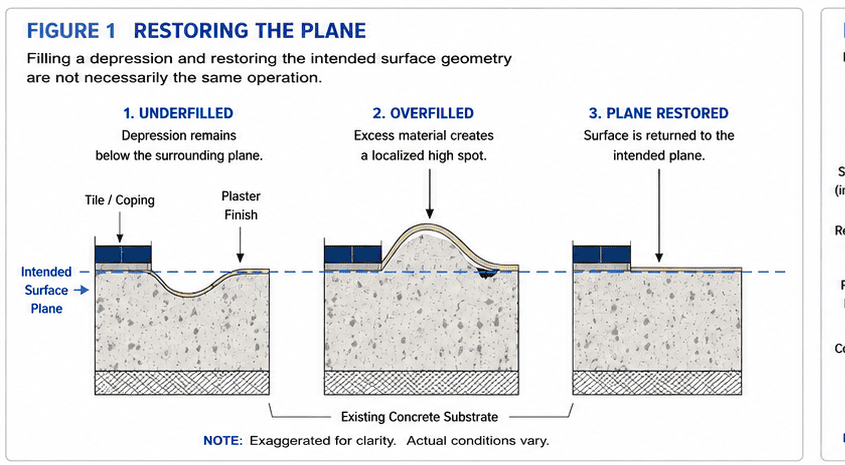
This distinction helps explain why some newly finished pools appear wavy. A plaster finish is applied by hand, and some variation is inherent in that process.
Industry guidance recognizing hand-applied variation should not be read as a conclusion that every observable wave, dip, hump, or transition is unavoidable. It also does not identify the mechanism that produced a specific condition.
The important question is whether the finish reasonably follows the intended pool geometry or reflects underlying or application-related irregularities that were not adequately addressed.
Water and light reveal geometry differently
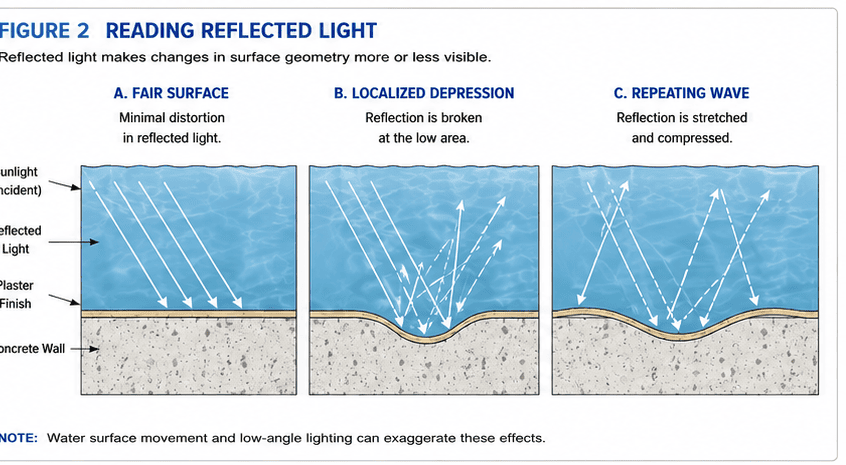
A dry pool observed from directly above may appear relatively uniform. Once filled, moving water and reflected sunlight can make subtle undulations far more noticeable.
Low-angle artificial lighting can exaggerate those variations even further. This is similar to examining the side of an automobile. A small wave may be difficult to see when looking directly at the panel but obvious when a reflected line passes across it.
Viewing conditions matter. A full pool viewed under ordinary natural light may present differently than the same pool viewed at night with an underwater light projected across the wall.
Hydration: water is part of the chemistry
Water does more than make plaster easy to move. Cement reacts with water as the material develops its hardened structure.
It is misleading to treat water as though the only question were whether the mixture feels dry or wet. The material needs the intended proportioning, mixing, placement, finishing, and moisture environment to provide the finish with a reasonable opportunity to develop properly.
Insufficient effective hydration
A mixture or exposed surface that does not retain the moisture needed for cement hydration may develop differently than intended. Poor workability may also encourage handling or finishing adjustments that introduce additional variability.
Excess mixing water
Added water may improve immediate workability while altering the water-cement relationship. As excess water leaves, it can contribute to greater porosity, lower density, color variation, and dimensional change.
The correct lesson is not that wetter plaster is better or that drier plaster is automatically stronger. The lesson is that uncontrolled water addition is a meaningful variable.
Hydration, evaporation, and shrinkage cracking
Fresh cementitious material undergoes volume changes. When moisture leaves an exposed surface rapidly while the material has little tensile capacity, shrinkage stresses can develop.
If those stresses exceed what the fresh material can resist, cracking may occur. Wind, low humidity, warm air, a hot substrate, direct solar exposure, and the temperature of the fresh material can all influence evaporation.
These variables do not act independently. A moderately warm day with strong wind and low humidity may create a more demanding surface condition than a hotter but calm and humid day.
Cracking also cannot automatically be assigned to weather from appearance alone. Mix proportions, thickness, restraint, substrate movement, preparation, curing, and later service conditions may also matter. Weather is one part of the evidence, not a complete diagnosis.
One swimming pool can contain several microclimates
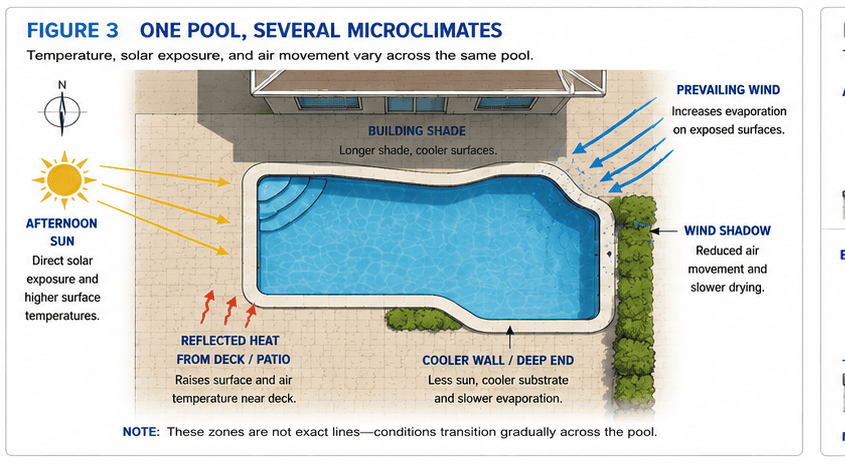
A crew does not necessarily apply plaster under one uniform set of conditions. The deep-end wall may be shaded while a sun shelf is exposed to direct sunlight.
One wall may absorb heat for hours while another remains cooler. A house, privacy wall, raised deck, or landscape feature may block wind in one area and accelerate it through another.
Even within the same swimming pool, different surfaces may therefore have different temperatures, evaporation rates, working times, and hydration environments.
Direct sun
Solar exposure can heat the substrate and fresh finish, shorten the available finishing window, and increase the demand for moisture control.
Shade
Shaded areas may remain cooler and workable longer than surfaces on the opposite side of the same pool.
Wind paths
Air movement around buildings, fences, raised decks, and landscaping can expose certain surfaces to substantially greater evaporation.
If different portions of a pool develop different texture, coloration, cracking, or surface characteristics, their orientation and environmental exposure may be relevant.
That pattern does not prove causation, but it can help guide a systematic investigation.
A finished pool may contain many separate batches
An owner sees one continuous interior surface. The crew may have produced that surface using many individual batches delivered over time.
If each batch contains a different quantity of water, receives a different mixing duration, waits a different amount of time before placement, or is adjusted differently in the field, the pool may not be receiving one truly uniform mixture.
Production methods vary. Wheelbarrows, portable mixers, larger batch equipment, ready-mix delivery, and pumping systems can each be used within different workflows.
Equipment alone does not guarantee quality. The controlling issue is whether the chosen system maintains the specified material proportions and a repeatable process from the first batch to the last.
Questions about batching
How is water measured? Is mixing time controlled? How are field adjustments handled? What prevents one batch from becoming substantially wetter or drier than another?
Questions about timing
How long does material wait before placement? Are delays documented? Can the crew maintain a continuous workflow without using additional water to recover material that has lost workability?
Finishing tools influence pressure and surface geometry
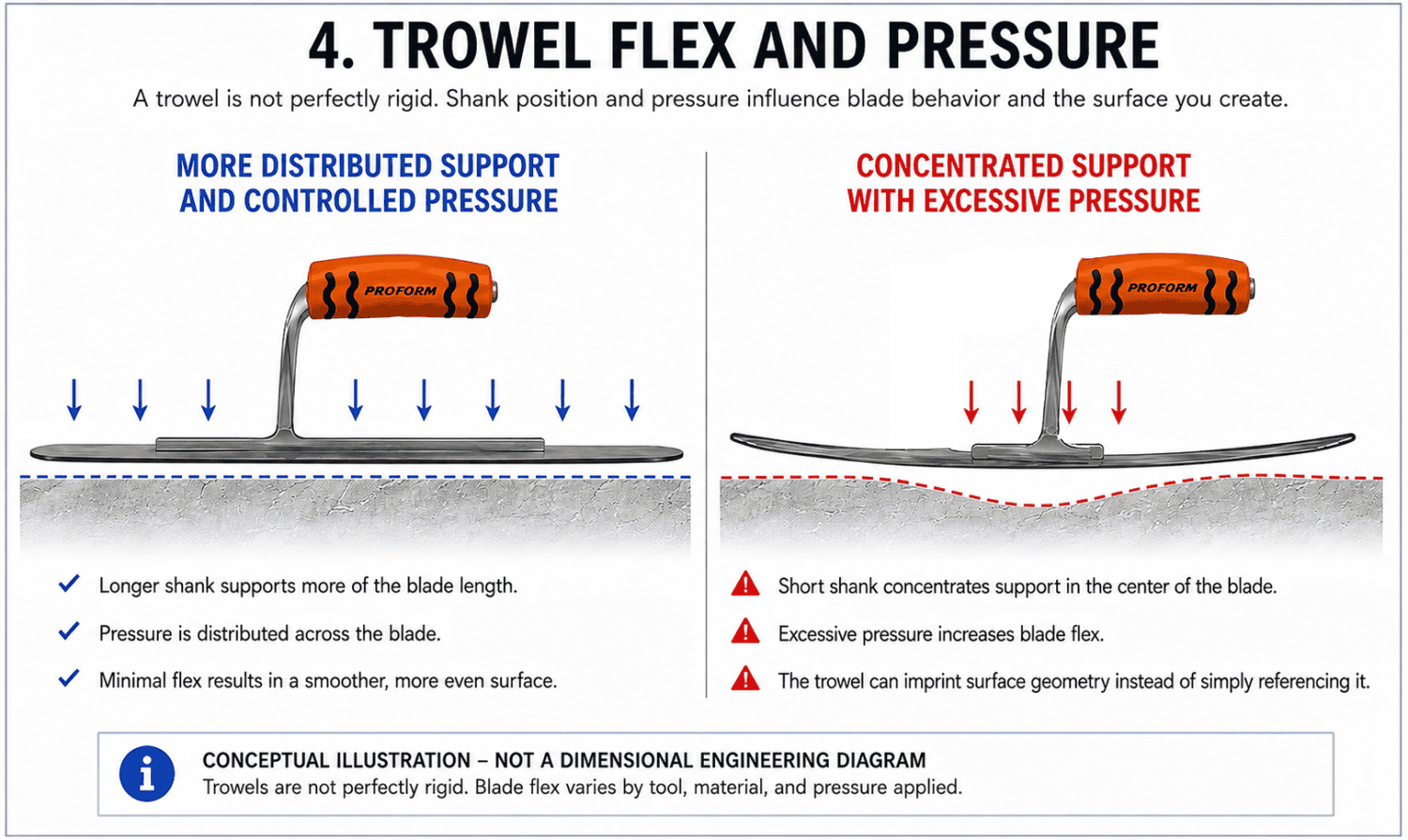
A plaster trowel is not perfectly rigid. Its blade bends as the applicator applies pressure.
Blade length, blade stiffness, shank length, shank configuration, angle, hand position, material condition, and operator technique all affect how force reaches the surface.
A long-shank pool trowel supports the blade across a greater portion of its length. A short-shank design concentrates that connection within a narrower area near the center of the blade.
When heavy pressure is applied to a long blade with concentrated central support, the unsupported portions can flex differently than they would with a longer support member. The tool can then begin imparting its own changing geometry into the finish.
This does not mean that a particular tool automatically produces good or bad workmanship. Skilled finishers select and use different trowels for different stages, materials, and conditions.
It does mean that more pressure is not automatically better pressure.
The fill water becomes part of the startup environment
“Fill the pool” may sound like a simple final step. It is not. The source water introduces its own chemistry immediately after the finish has been installed.
Municipal water, private well water, softened water, filtered water, and water delivered by truck may differ in pH, alkalinity, calcium hardness, dissolved metals, temperature, and treatment history.
Those differences can affect startup planning and the interpretation of later staining, scaling, color change, or surface distress.
Well water
May contain iron, manganese, hardness, or other constituents that warrant testing and an appropriate filling strategy.
Softened water
May have significantly reduced calcium hardness. Applicable finish manufacturer and startup requirements should be followed.
Filtered or treated water
“Filtered” does not describe every relevant chemical characteristic. Actual test results matter more than the label applied to the water.
Fill water should be evaluated for the characteristics relevant to the selected finish and startup method. Proprietary finish manufacturers may have additional instructions that should control for their products.
Filling and startup remain part of the installation
The project does not end when the last trowel leaves the pool. Fill timing, continuity, water contact, filtration, brushing, and chemistry management may influence the developing finish.
Applicable finish instructions commonly call for filling to begin at the appropriate time and to continue without interruption until the intended operating level is reached.
An interrupted fill can leave a visible line. Prolonged exposure of fresh finish above a stopped water level may also create a different moisture and curing environment than the submerged portions of the pool.
Manufacturer-specific instructions remain important. Different products may require different treatment, fill, or startup procedures.
The parties should identify in advance who is responsible for starting and stopping the water, testing the source water, starting circulation, brushing, chemical additions, and documenting the initial conditions.
Pool Envy uses PoolWash—not muriatic acid on new plaster
A newly applied cementitious finish should not automatically be treated with muriatic acid simply to force a particular appearance. Acid changes the surface being evaluated. It can consume cement paste, expose aggregate, alter texture, and complicate later efforts to determine what condition existed before the treatment.
Pool Envy uses PoolWash as part of its new-plaster cleaning and startup approach rather than making a routine muriatic-acid treatment the default. The objective is to clean and manage the developing finish without unnecessarily etching the cementitious surface.
The applicable finish manufacturer’s instructions, PoolWash instructions, source-water chemistry, and actual field conditions should still govern. No single cleaning or startup procedure is appropriate for every finish and every pool.
Is it normal variation or a pool plaster problem?
Hand-applied cementitious finishes are not manufactured sheets. Some variation in levelness, smoothness, texture, thickness, aggregate exposure, and coloration should be expected.
Normal mottling and variation may occur as moisture content, material placement, finishing, and cement hydration vary within the surface.
At the same time, describing plaster as hand-applied does not identify the cause of every condition, establish that every result is reasonable, or resolve whether a specific pool was prepared and finished appropriately.
A useful evaluation may consider:
- Is the condition distributed generally or concentrated in one area?
- Does it correspond with sun exposure, shade, prevailing wind, or a particular wall?
- Does it follow a repair, fitting, penetration, transition, bench, step, or previously damaged area?
- Is it visible only under unusual lighting, or can it also be seen or felt under representative conditions?
- Was it present immediately after filling, or did it develop later?
- Do project photographs, batch records, weather data, fill records, or chemistry logs exist?
- Is the concern aesthetic, functional, safety-related, or associated with measurable deterioration?
The answer may require visual inspection, surface sounding, measurement, document review, water testing, laboratory analysis, destructive testing, or another discipline.
Not every project needs every form of testing. Testing should be selected to answer a defined question.
What might additional project investment actually provide?
This resource intentionally does not publish plaster prices. Regional labor, pool size, access, finish selection, demolition, repair needs, logistics, and many other factors make generic figures unreliable.
More importantly, the proposal total does not reveal whether additional money is being spent on meaningful quality controls.
When proposals differ, owners should look for explainable differences in the work.
More evaluation
Documentation, sounding, measurements, mockups, sample testing, and deliberate review of substrate conditions.
More preparation
Removal of unsound material, treatment of penetrations and transitions, repairs, cleaning, and restoration of surface geometry.
More process control
Consistent batching, trained supervision, weather planning, controlled timing, documentation, fill-water testing, and managed startup.
Those items can require additional labor, equipment, materials, time, and expertise. They can help explain a higher proposal.
Their presence still does not guarantee perfection, and their absence cannot be proven merely because a proposal is lower.
Questions worth asking before pool resurfacing
- How will the existing finish and underlying substrate be evaluated?
- How will hollow, loose, contaminated, or deteriorated areas be handled?
- Does the proposal include restoring damaged or irregular surface geometry before the finish coat?
- What finish manufacturer and written installation instructions apply?
- How will batch proportions, water addition, mixing time, and placement timing be controlled?
- How does the crew respond to wind, direct sun, high surface temperature, or changing weather?
- What source water will fill the pool, and will it be tested before or during startup?
- Who controls the fill, and what happens if it stops?
- Who is responsible for startup chemistry, brushing, filtration, and documentation?
- What records will be provided if a disagreement later develops?
Clear answers do not guarantee a flawless finish. They do help distinguish a defined process from a proposal that identifies only the final product.
Document the condition before altering it
Owners understandably want a disappointing finish corrected quickly. However, aggressive cleaning, draining, acid treatment, sanding, polishing, patching, chemical adjustments, or another resurfacing can change or destroy evidence of the original condition.
Before authorizing major corrective work, consider preserving:
- Wide and close photographs under ordinary natural-light conditions.
- Photographs under the lighting that first revealed the concern, clearly identified as unusual or diagnostic lighting where applicable.
- The contract, proposal, change orders, product records, and warranty.
- Demolition, preparation, mixing, application, filling, and startup photographs or video.
- Weather records and approximate work times.
- Fill-water source, test results, fill timing, interruptions, and startup logs.
- Written communications describing when the condition was first observed and how it changed.
When the explanation is “that is just plaster,” the investigation may not be finished
Some variation is inherent in a hand-applied cementitious finish. That general principle does not determine what caused a specific condition, whether one area differs materially from surrounding work, or whether preparation, installation, filling, and startup were consistent with the applicable project requirements.
Pool Envy® evaluates swimming-pool conditions from a diagnostic perspective. Depending on the engagement, that work may include visual observations, construction-document review, comparison with applicable manufacturer instructions and industry guidance, photographic documentation, testing recommendations, and identification of questions requiring another qualified professional.
Pool Envy does not substitute contractor observations for structural, geotechnical, chemical, or materials-engineering determinations. When engineering analysis is required, the appropriate licensed professional should be retained.
Begin a Written Consultation IntakePool plaster problems and renovation outcomes
Are waves in new pool plaster always a defect?
No. Hand-applied cementitious finishes inherently contain some variation, and lighting can exaggerate surface geometry. However, unusual or localized waviness may warrant evaluation of the underlying surface, preparation, transitions, thickness, finishing process, and representative viewing conditions.
Does paying more guarantee better pool plaster?
No. A higher proposal guarantees only that more was paid. Additional expense may support better evaluation, preparation, supervision, equipment, process control, and startup, but the proposal total alone does not prove that those measures were included or executed properly.
Can too much water affect pool plaster?
Uncontrolled additional water can change workability and the water-cement relationship, potentially affecting density, porosity, shrinkage, strength development, color, and finish consistency. The applicable product instructions and approved mix design should govern.
Can too little water or moisture also create problems?
Cement requires water for hydration. A mixture or exposed surface that lacks the moisture environment needed for proper hydration may not develop as intended. The correct principle is controlled proportioning and curing, not simply making the mix wetter or drier.
Can wind contribute to plaster cracking?
Wind can increase surface evaporation. In combination with temperature, low humidity, direct sun, substrate temperature, material properties, restraint, and curing conditions, rapid moisture loss can increase the risk of early shrinkage cracking. A crack cannot be attributed to wind from appearance alone.
Why might one side of the pool look different from another?
Different areas may experience different substrate temperatures, sun, shade, wind, timing, crew technique, batch material, thickness, and hydration conditions. The pattern and project history should be examined before selecting a cause.
Does well water matter when filling a new plaster pool?
It can. Well water may contain metals, hardness, alkalinity, or other constituents relevant to startup. Municipal, softened, filtered, and trucked water can also differ. Source-water testing helps establish an appropriate startup plan and useful baseline documentation.
Should a newly plastered pool be filled continuously?
Applicable industry and manufacturer guidance commonly calls for a continuous fill until the intended operating level is reached. Product-specific instructions should be followed. Stopping a fill can produce a visible line and may affect the exposed finish.
Why does Pool Envy avoid routine muriatic-acid treatment on new plaster?
Acid can consume cement paste, expose aggregate, alter texture, and change the surface that is being evaluated. Pool Envy uses PoolWash as part of its new-plaster cleaning and startup approach rather than making routine muriatic-acid treatment the default.
Can Pool Envy determine whether plaster is structurally sound?
Pool Envy can document field conditions and provide contractor-level technical observations within the scope of an engagement. Structural, materials-engineering, geotechnical, or laboratory determinations may require a licensed professional engineer or qualified testing laboratory.
Technical references used for this resource
The following resources provide general industry and concrete-technology context for the principles discussed on this page:
- National Plasterers Council: Swimming Pool Interior Finish Tolerances
- National Plasterers Council: Filling the Pool and Initial Startup
- National Plasterers Council: Pool Interior Finish Disclosure
- American Concrete Institute: Curing and Plastic-Shrinkage Considerations
These references provide general technical context. Project-specific contracts, approved product data, manufacturer instructions, construction records, field conditions, and applicable law may contain additional or controlling requirements.