

How to Winterize a Pool in Green Bay (Pro Checklist)
Local guidance from licensed contractors. This covers in-ground pools typical to NE Wisconsin; always follow your equipment manuals and local AHJ.
1) Clean & Balance
- Skim, brush, and vacuum; empty baskets.
- Adjust pH to roughly 7.2–7.6; bring chlorine to shock level per sanitizer type.
- Run the pump to circulate chemicals; remove ladders/handrails if your cover requires it.
2) Lower & Blow Out
- Lower water to just below the skimmer mouth (mesh covers may vary; solid safety covers often allow normal level with gizmo).
- Open unions; remove drain plugs from pump, filter, heater; set multiport to “Winter” or between detents.
- Use low-pressure air at the pad to blow water from equipment toward the pool—returns first, then skimmer(s).
- Install return plugs; use a skimmer gizmo or threaded plug to protect the throat.
Antifreeze is optional when lines are fully cleared. If used, choose pool-safe propylene glycol and never automotive antifreeze.
3) Cover & Protect
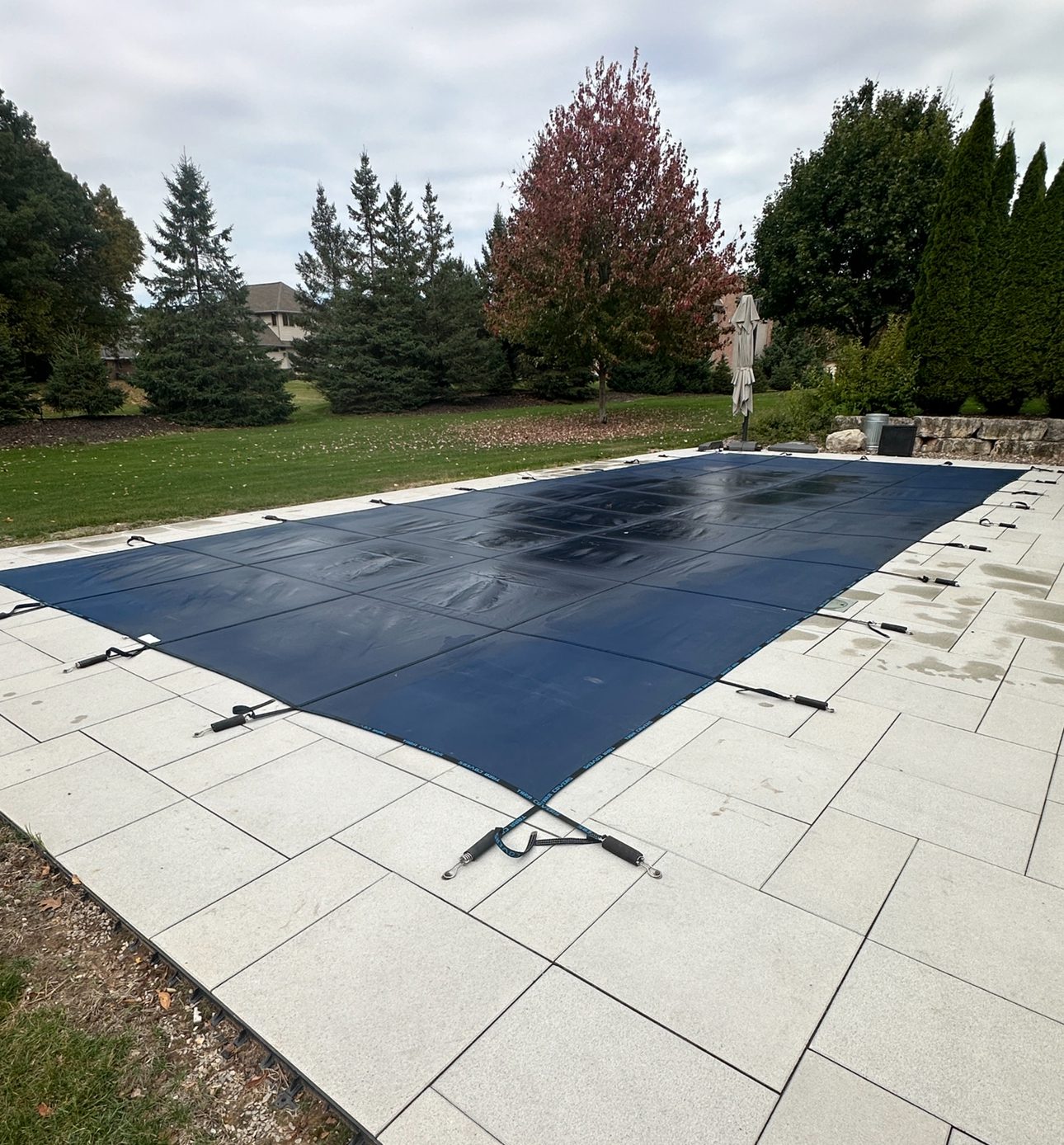
- Install your safety cover with correct spring tension; remove ladders/rails as required.
- Store drain plugs in the pump basket; loosen unions slightly to avoid freeze-pinch.
- Shut off power at the equipment subpanel; label breakers (pump/heater/lighting).
Green Bay specifics
Freeze–thaw swings and wind load are hard on covers and anchors. Verify cover anchors, treat rails/anchor sockets with silicone, and check tile lines on raised walls—keep ice off tile where possible.
When to call a pro
Heaters (drain-hose manifolds), automation/valve actuator positions, and mixed plumbing (spa spillways, water features) are easy to miss. We photo-document the close and leave a checklist for spring.
Licensing: FL CPC1460695 • TX TICL 1350 • WI Electrical & Dwelling Contractor. Photos from Pool Envy® projects.
Cold-Weather Water Balance: Use Calcium to Hold LSI Near Zero at 32°F
As water cools, the Saturation Index (LSI/CSI) drops ~0.4 from 60°F to 32°F. That colder water becomes
more aggressive to plaster, grout, metal, and fittings—especially after **acidic rain or snow-melt** dilutes
alkalinity and calcium under a mesh cover. The fix is simple: **close with a slightly higher calcium hardness
and a buffered pH/alkalinity** so your LSI stays around 0.00 when water is near freezing.
Closing Chemistry Targets (Green Bay)
| Pool Type | pH | Total Alkalinity | Calcium Hardness | Goal LSI @ 32°F |
|---|---|---|---|---|
| Plaster/Quartz | 7.8–7.9 | 110–140 ppm | 350–400 ppm | ≈ 0.00 (−0.05 to +0.05) |
| Vinyl/Fiberglass | 7.9–8.0 | 140–160 ppm | 200–260 ppm (or raise to ~300 if you prefer pH ≤7.9) | ≈ 0.00 |
These ranges are chosen so the **cold-water LSI** lands near 0.00. Warmer months can use your normal (often lower) CH/TA.
Why it Works
- Temperature factor falls toward 0.00 as water approaches 32°F → LSI drops.
- Acidic rain/snow-melt lowers pH/alkalinity under mesh covers → LSI drops again.
- Extra calcium + a buffered pH/TA at closing offsets those drops, keeping LSI ≈ 0 so water doesn’t dissolve plaster or metals all winter.
~1.25 lb of 77–80% calcium chloride per 10,000 gal raises CH ≈ 10 ppm. Pre-dissolve, add in small
portions to the deep end with the pump running, and keep pH/TA adjustments a few hours apart to prevent clouding.
Worked Examples (what we aim for)
| Scenario | At Closing (~60°F) | At 32°F | Result |
|---|---|---|---|
| Plaster (prefer lower pH) | pH 7.8 • TA 140 • CH 360 → LSI ≈ +0.40 | Same water at 32°F → LSI ≈ 0.00 | Cold water stays non-aggressive |
| Plaster (allow slightly higher pH) | pH 7.9 • TA 120 • CH 360 → LSI ≈ +0.44 | At 32°F → LSI ≈ +0.04 | Also safe (still near neutral) |
| Vinyl/Fiberglass (keep CH modest) | pH 8.0 • TA 150 • CH 220 → LSI ≈ +0.40 | At 32°F → LSI ≈ 0.00 | Uses TA/pH to offset low CH |
Don’t overshoot. If CH will exceed ~400–450 ppm in spring, stop and rely more on TA/pH during winter. Always follow heater/filter manufacturer manuals for chemistry limits.